
Moisture-resistant drywall in bathrooms and on balconies: where it works and where it does not
When a green board is genuinely needed, how it differs from a standard one, why it is not waterproofing on its own, and what must be done before tiling and painting.
The green board is often treated as a guarantee against water: fit moisture-resistant drywall and stop worrying about damp. In practice it does not work that way. A moisture-resistant board copes better with humid air, but it is not waterproofing and it will not save you from a leak, condensation or missing ventilation.
- Moisture-resistant board is designed for humid air, not direct water
- Wet zones under tile need separate waterproofing
- Access hatches to valves and joints are planned before filling
- Without ventilation even the right board will not fix the problem
- Near the sea and on balconies the material requirements are stricter
How the moisture-resistant board differs
Moisture-resistant drywall has a treated core and impregnated liner, so it takes up airborne moisture more slowly and loses strength less quickly. That does not make it waterproof: in direct, prolonged contact with water it breaks down too. The difference is how long the build-up survives in a humid environment and how it behaves through the humidity swings after a shower.
Where it is genuinely needed
Bathrooms, shower areas, the space around a bath, boxes around risers and traps, the kitchen near the sink and hob, balcony zones, and walls against external walls in coastal towns. In these places humidity rises regularly and surfaces may not dry out in between. A separate category is rooms with no window and poor extraction, where moisture lingers longest.
Where paying extra makes no sense
In dry rooms, hallways, bedrooms, living rooms and ceilings outside wet zones a standard board is enough. Switching an entire flat to moisture-resistant board just in case raises the cost with no real benefit. That money is better spent on proper joint preparation and a working extractor in the bathroom.
Waterproofing is a layer, not a property of the board
Under tile in a shower and around a bath, waterproofing is applied: a liquid membrane over the surface, tape in corners and at the junctions with wall and floor, and separate detailing where pipes pass through. It is its own stage and is not replaced by choosing a board. Skip it and water finds a way through a corner or junction and wets the build-up from inside, where nobody sees it until stains appear.
Access hatches and reaching services
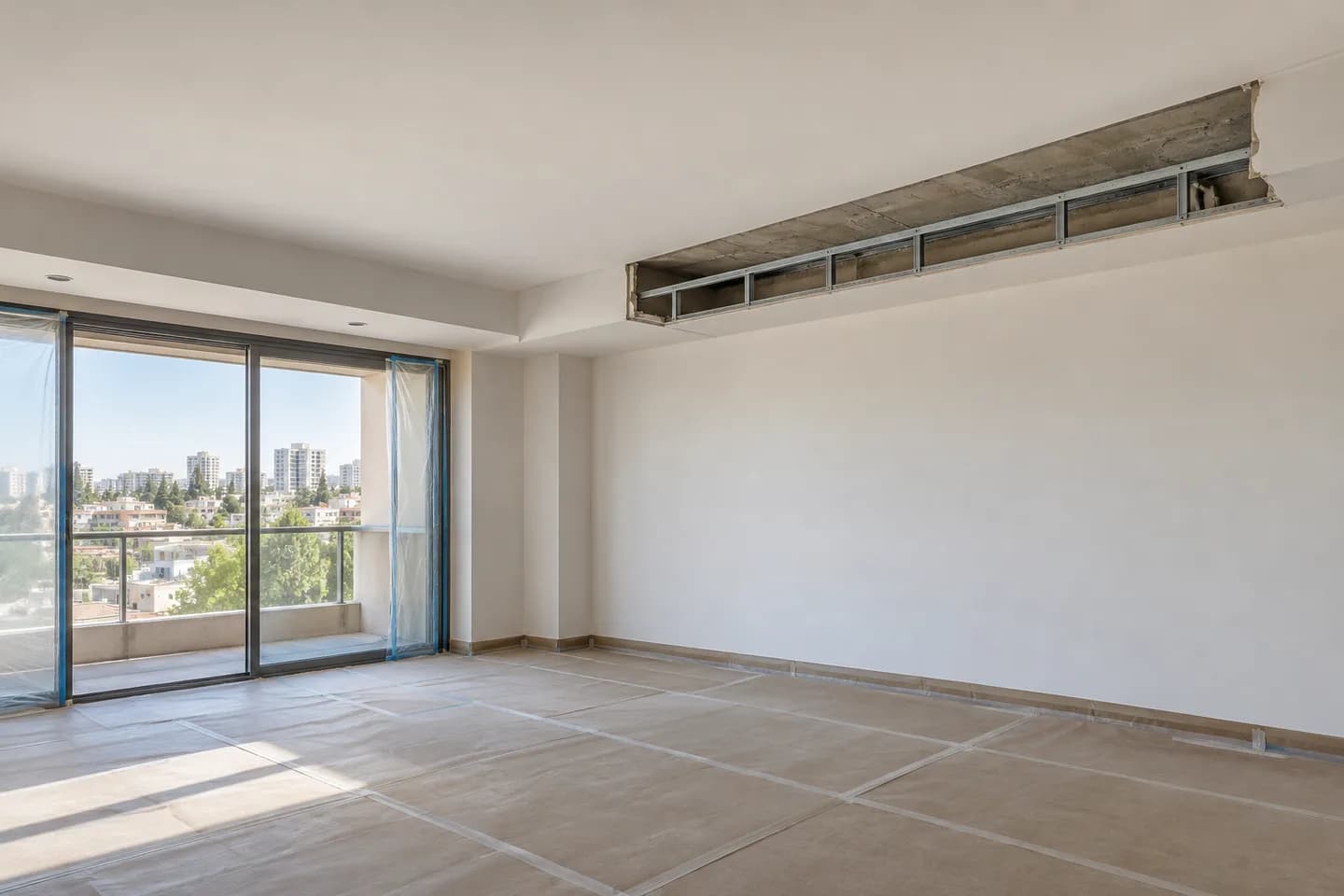
If a box contains valves, pipe joints, filters, a trap, a power supply or a meter, they need to remain reachable. The hatch is planned before filling, because afterwards its opening has to be cut through finished work. A sealed box looks tidier right up until the first leak — then the tile comes off, which costs more than the repair itself.
Ventilation matters more than the board grade
The main cause of mould and blistering is not the material but moisture with nowhere to go. If the extractor does not work, or was blocked during the renovation, humid air stays in the room and settles on cold surfaces. Before starting it is worth checking the draw the simple way: a sheet of paper should be pulled against the grille. If it is not, ventilation gets fixed before finishing, not after.
Coastal towns are a special case
In Netanya, Haifa and other seaside towns background humidity is higher and external walls are more often cold on the inside face. There moisture-resistant board is used not only in the bathroom but on balcony zones and against external walls, and primer and paint選択 are treated more strictly. Standard paint in such a zone shows stains, darkening and corner peeling much sooner.
What to check before work begins
Before quoting we look at: whether there are damp marks or mould on existing surfaces, whether the extractor works, where pipes run and where hatches will be needed, and what finish is planned — tile, paint or moisture-resistant plaster. If mould is already present, the cause is found and damaged layers removed first: covering it with a new board is pointless, the problem stays inside the build-up.
For a bathroom ceiling with ventilation, access and a priced example, see the Or Akiva guide.
Questions
Can tile go straight onto moisture-resistant drywall?
In a dry zone usually yes, given a correct frame and primer. In a shower and around a bath, waterproofing goes on first and tile after. Without it water tracks through joints and corners into the build-up.
Is a moisture-resistant board enough in a shower?
No. It is designed for humid air, while a shower brings direct contact with water. That needs waterproofing, correct falls, sealed junctions and working extraction.
Why is there mould when a green board was used?
Usually because moisture has nowhere to go: the extractor does not work, there is a leak, or a cold external wall is producing condensation. The material only slows the process, it does not remove the cause.
Does a moisture-resistant box need an access hatch?
If it contains valves, joints, filters, traps or equipment, yes. Otherwise any minor repair turns into stripping finished work.
What paint should be used on moisture-resistant drywall?
In a dry zone standard paint is sometimes fine; in wet rooms use a primer and paint rated for humidity. Otherwise staining, uneven sheen and blistering appear much sooner.
What should I send for a bathroom estimate?
An overall view of the room, the pipe and riser zone, the ventilation grille, external walls, close-ups of any damp marks and rough dimensions. That is enough to see the scope and whether hatches are needed.
Relevant services
Guides and practical notes

Message Nikolai on WhatsApp with photos and dimensions, or call him to discuss the next step and what is needed for an estimate.