
Choosing drywall boards: standard, moisture resistant and specialist
Choose drywall systems for Israeli homes: dry and wet zones, showers, ceilings, fire performance, acoustics, tiles, loads and material checks.

Board selection is often reduced to colour: standard boards for rooms, green boards for bathrooms and special boards for demanding work. That can be an initial clue, but it is too simple for a renovation specification. Product identification, permitted conditions, framing, finish and details around water all matter. Moisture resistant board does not replace waterproofing, a fire related board does not prove the performance of an entire wall, and an acoustic label does not guarantee quiet. This guide helps prepare questions for an Israeli home renovation and identify where a specialist product is justified. The aim is to choose a compatible assembly suited to the actual conditions.
1. Map the exposure in each zone
Separate ordinary dry use, intermittently humid air, splashes near a basin, direct shower water and concealed service spaces. The word bathroom does not describe identical exposure on every wall and ceiling. Check ventilation, windows, usage and the existing substrate. A kitchen wall above a worktop differs from one beside the dining table. Continuously humid spaces may need a construction beyond a conventional domestic arrangement. Ask the contractor to mark zones on a plan and identify a system for each. This makes material selection respond to actual exposure instead of assigning one colour to the whole apartment without further investigation.
2. Understand standard board applications
Standard boards are used in manufacturer specified dry internal conditions, including partitions, linings and ceilings without additional requirements. Correct construction can provide a flat substrate for finishing. This does not mean that any thickness is suitable for any wall height or ceiling arrangement. Profiles, spacing, fixings and layers belong to the system specification. A specialist board may offer little relevant benefit for a basic residential task. Begin with wall lining or partition planning, then check the restrictions. Sensible savings remove unnecessary properties while preserving the materials and details required by the selected construction.
3. Moisture resistance is not waterproofing
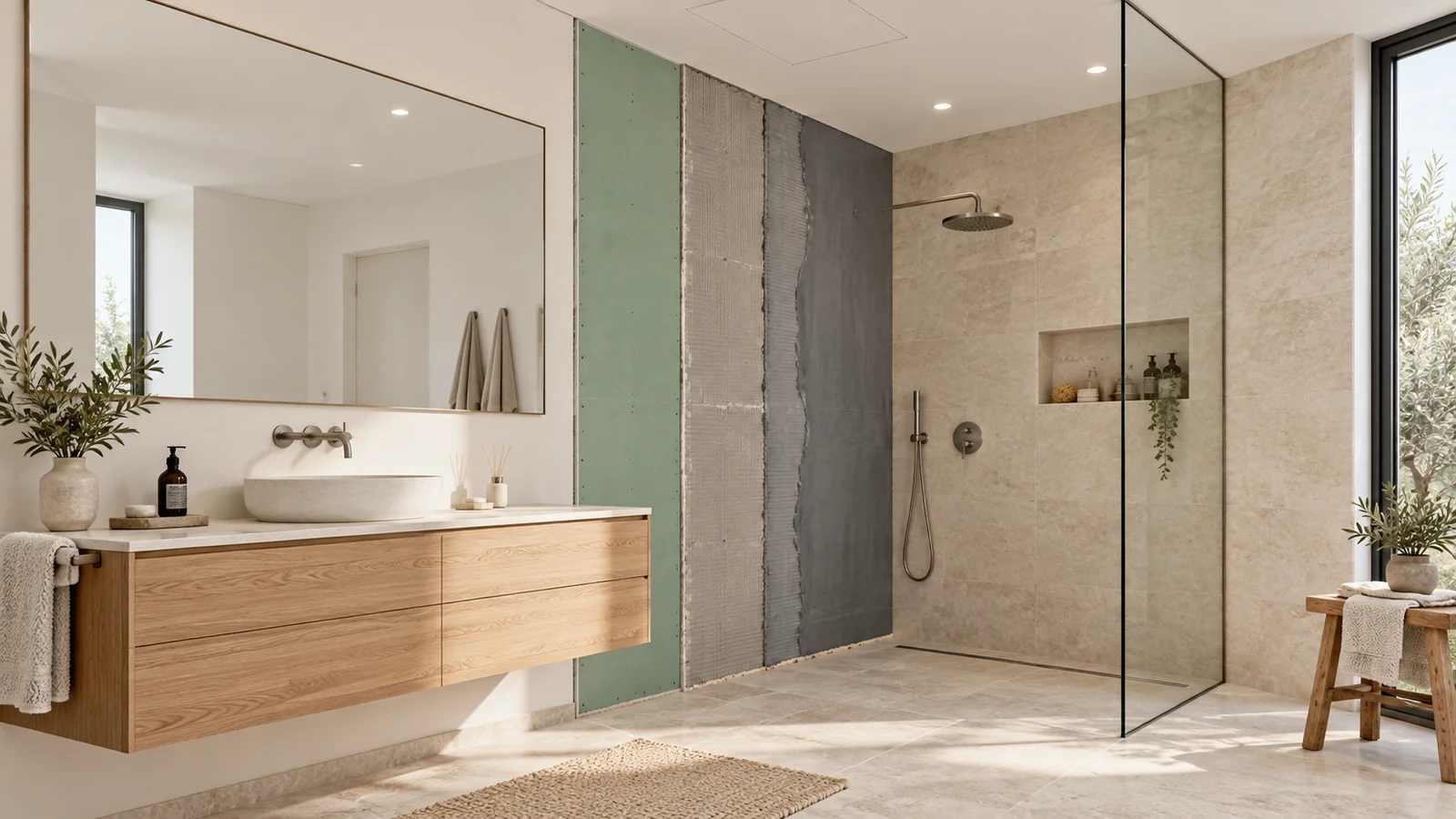
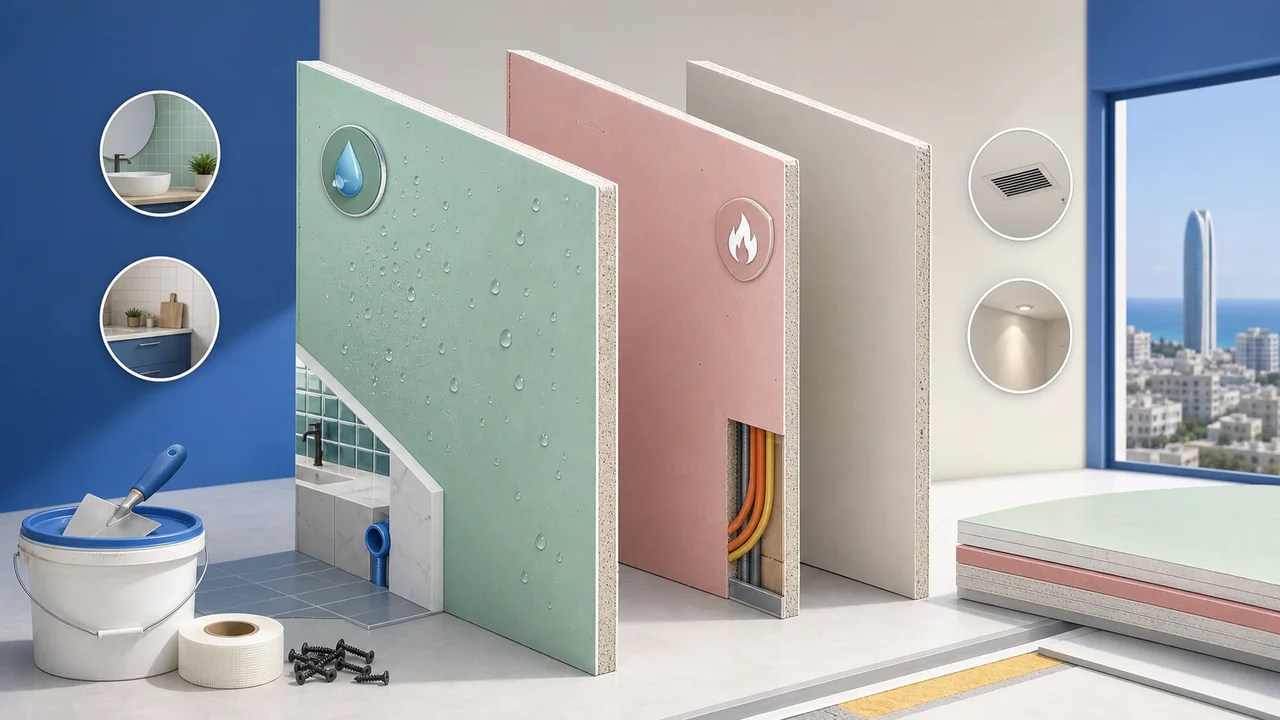
A moisture resistant gypsum board has properties for stated humid conditions, but does not form a waterproof enclosure by itself. Direct wet exposure may require a suitable substrate and a separate compatible waterproofing system. Joints, corners, pipe penetrations, connections and the finish all belong to the solution. Colour coding varies, so read the product name and technical information. Do not accept a claim that a green board can remain continuously wet without documentation for that application. Specialist board installation begins with exposure and the complete arrangement rather than a simple substitution of coloured facing paper.
4. Specify the shower separately
Assess direct water exposure, tile finish, fixings and every penetration in the shower area. Cementitious or another specialist board may be selected, but it does not remove the need for the joints and waterproofing required by its system. Do not transfer an overseas construction to a local product simply because both are described as moisture resistant. Selection should follow documentation for the products supplied in Israel and the room design. Before tiling, agree responsibility for the substrate, waterproofing and inspection. Without a coordinated detail, a defect may fall between two contractors even though each has completed their own visible portion of the work.
5. Assess bathroom ceilings independently
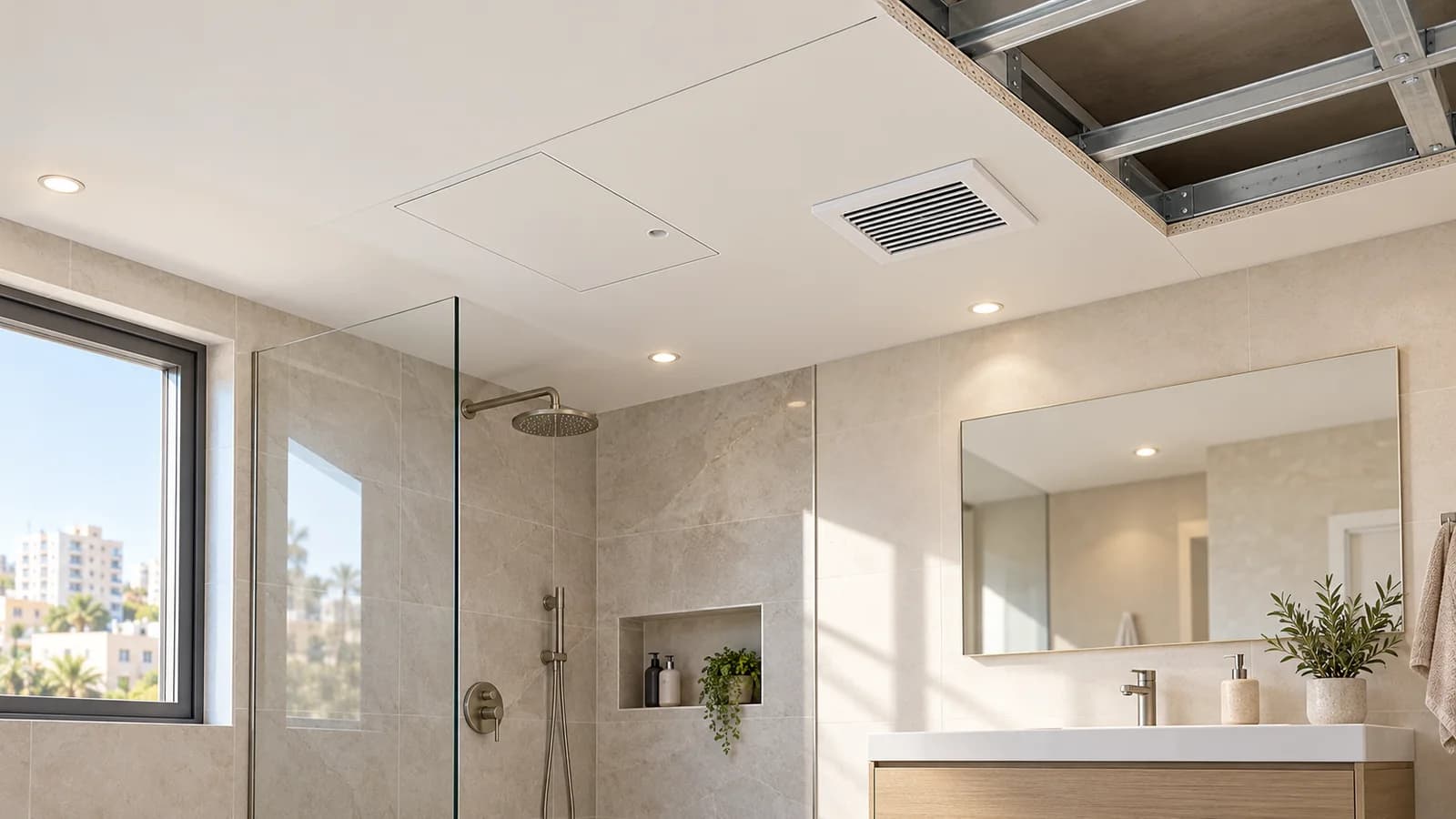
The ceiling faces humid air, possible condensation and maintenance demands, while services may run above it. Choosing a board cannot repair an overhead leak or inadequate extraction. Inspect the base, component condition, service routes and access before installation. Lights and hatches need compatible details, and the finish must suit the use conditions. Keep access to plumbing and electrical components. The guide to drywall ceilings covers height and inspection openings. Do not close a wet base simply for a quick visual result. Correct the cause first, then decide which elements can remain and what new assembly is appropriate.
6. Fire performance belongs to the assembly
A board with relevant properties is used within systems specifying framing, layers, fixing, joints and perimeter details. Its colour or label alone does not assign an arbitrary fire resistance duration to a wall. Cable and pipe penetrations, doors and access panels also need consideration. When a room has particular requirements, use a suitable documented design; component substitutions require assessment. Avoid inventing a requirement for a domestic room without a reason, and avoid replacing a commercial requirement with a broad verbal promise. The project and competent specialists determine what is needed. Keep the selected construction identified so that later service work does not inadvertently change it.
7. Acoustic boards work with other components
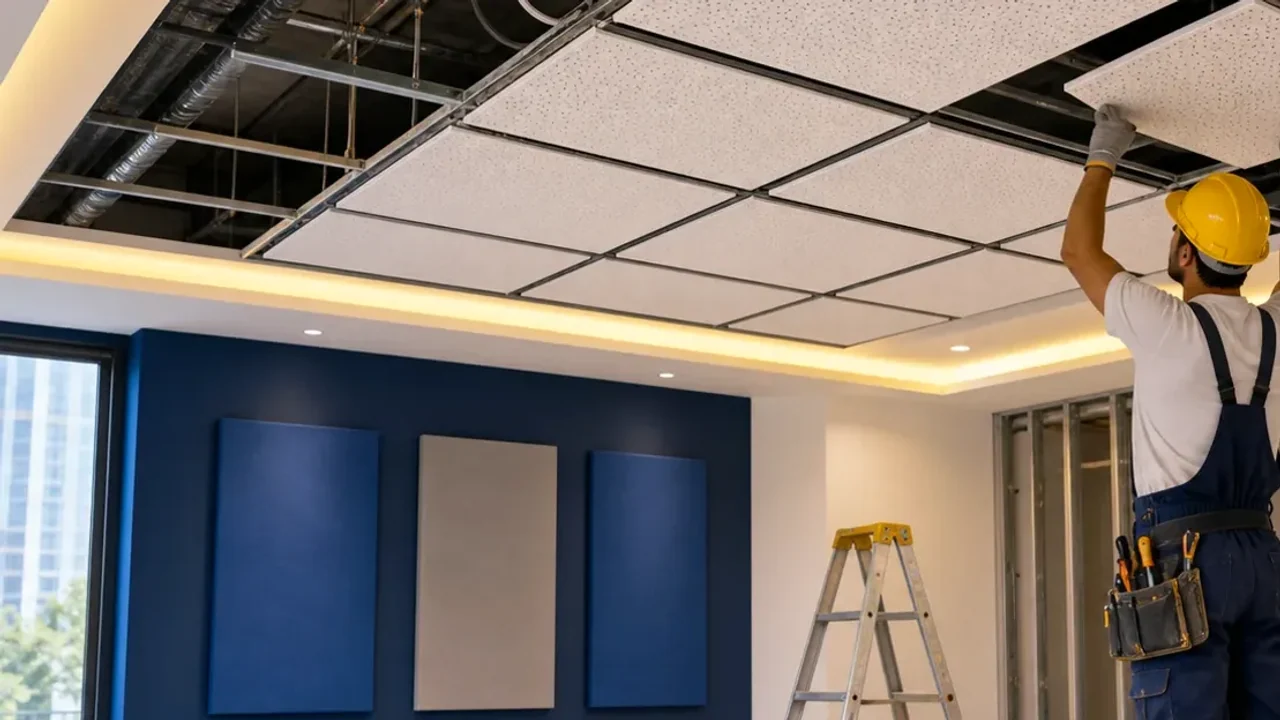
Additional mass or specialist facing properties can contribute to a sound insulating construction. The outcome also depends on framing, cavity, filling, fasteners, seals and flanking routes. One board fixed to different substrates does not provide a universal result. For an office partition, read about doors, sockets and ventilation. For room echo, see living room acoustics: a dense smooth board and an absorbing surface serve different tasks. First identify the mechanism, then choose material properties that contribute to that solution. This keeps the product specification connected to a practical goal.
8. Allow for tiles and suspended loads
Heavy finishes, cabinets, mirrors and sanitary equipment require load checks and a suitable system. Identify tile dimensions and mass, adhesive method, furniture fixings and supporting elements. In bathrooms, preserve waterproofing details around fixings and penetrations. Heavy equipment may need an independent support. Do not choose framing solely by how flat the finished surface will look. Request support positions and photographs before boards close the construction. This avoids drilling blindly and discovering that expensive tiles conceal an unsuitable substrate. Make future installation responsibilities clear, particularly when furniture is fitted by a contractor who did not build the wall.
9. Compare the purpose of each product
The following comparison helps structure questions. It does not replace technical documentation, because each product has permitted conditions and installation details.
| Product | What to confirm | What it does not replace |
|---|---|---|
| Standard board | Dry use, thickness and assembly | Correct framing and joints |
| Moisture resistant board | Exposure limits and zones | Required waterproofing |
| Specialist acoustic board | Tested construction | Door and sealed details |
| Fire related board | Complete system and penetrations | Design confirmation |
| Cementitious board | Wet zone and finish | Specified water protection details |
Put the model, thickness, layers and compatible products in the quotation. This makes substitutions specific and allows proposals to be compared under matching conditions.
10. Check delivery and storage
Match markings to the agreed specification, and inspect edges and faces. Boards should not sit in an accidentally wet location or remain without suitable protection. Damaged paper, visible distortion or water marks need assessment before installation. Product properties apply to material in the stated condition, not to any damaged sheet with a similar colour. Save packaging information or photographs of identification, especially for specialist assemblies. Check joint and finishing products too: an incompatible compound can undermine an appropriate substrate. Storage and installation conditions follow the instructions for the chosen product rather than habits acquired with a different manufacturer's system.
11. Resolve causes before cosmetic repairs
Stains, softness, swelling and repeated cracks require investigation. A leak, condensation, substrate movement or an unsuitable detail may be responsible. New compound over the problem only changes the appearance. Before deciding whether to replace a whole board, assess the damage and permitted repair options. Once the cause is addressed, define removal and finishing. The article on skim coating and painting helps with dry finish checks. A practical repair plan explains why the damage occurred, what has been corrected and how to confirm that an active fault has not simply been concealed behind a fresh surface.
12. Prepare a useful specification enquiry
Send photos, town, dimensions, room use, water exposure, ventilation, future tiles and suspended items. For Hadera, Caesarea, Harish and northern Sharon, discuss the survey and coordination with a plumber or electrician. The material list needs framing, waterproofing stages where applicable, penetrations, access and the finish level. The guide to comparing renovation quotations explains how different scopes affect the final number. Good board selection means an appropriate system for real conditions, serviceable construction and clear responsibility at each stage. That is more useful than choosing the most expensive board throughout the property without a defined reason.
Technical reading
Knauf guidance on moisture resistant boards distinguishes moisture resistance from waterproofing. Regional instructions are reference material and do not replace documentation for the locally selected system.
See the Or Akiva guide for a worked bathroom ceiling, access and ventilation example.
Questions
Can I choose by colour alone?
No. Confirm the model, marking, permitted use and documentation from the actual manufacturer.
Is green board waterproof?
Moisture resistance is different from waterproofing. Wet exposure needs a complete compatible arrangement.
What belongs in a shower?
Select the substrate and water protection details for direct exposure using the system documentation.
Should every room use specialist boards?
Not necessarily. Standard products may suit dry zones without additional requirements.
Does a fire board guarantee a duration?
Performance belongs to the complete construction, including layers, framing, connections and penetrations.
Will acoustic board solve neighbour noise?
It may contribute, but the complete system and transmission paths determine the outcome.
Can a heavy cabinet be attached?
Plan the loads and suitable supports before boarding.
Can a damp base be concealed?
Investigate and correct the moisture source before deciding the restoration method.
What should be checked at delivery?
Model, thickness, damage, water marks and appropriate storage conditions.
What information helps selection?
Photos, dimensions, use, water exposure, ventilation, finishes and suspended loads.
Relevant services
Guides and practical notes
Message Nikolai on WhatsApp with photos and dimensions, or call him to discuss the next step and what is needed for an estimate.