
Ceiling Soundproofing Cost in Israel: Price per m², Method, Results
Ceiling soundproofing cost for upstairs neighbour noise: how a decoupled drywall ceiling works, what the price per m² includes, a price table and a bedroom example.
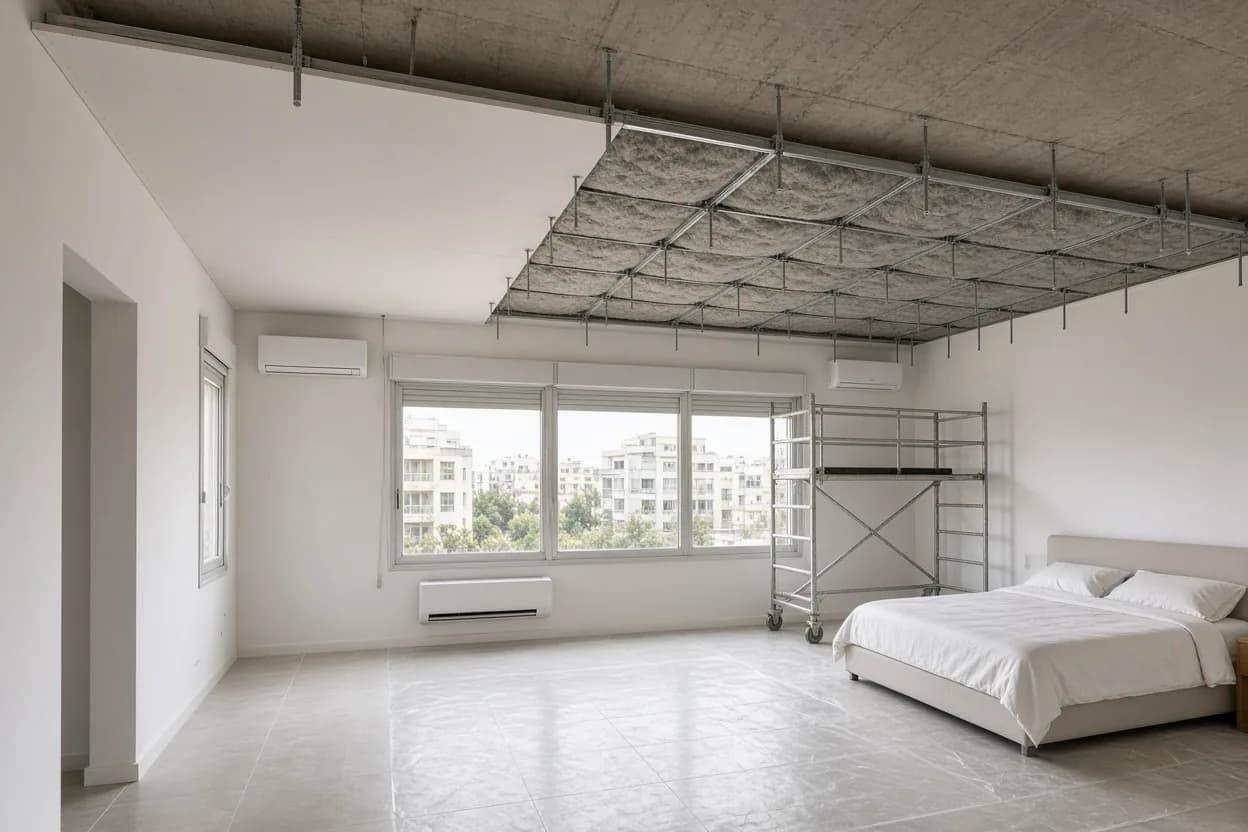
Ceiling soundproofing cost is usually the first thing people search for once the neighbours upstairs have become part of daily life: footsteps late at night, chairs scraping, a ball bouncing, conversations and the TV. The natural question is how much it costs per square metre. Before comparing numbers, though, it is worth answering three questions: what kind of noise is actually reaching you, what a suspended ceiling in your room can realistically change, and what exactly a quote needs to say so you can compare contractors on the same thing.
This guide explains in plain terms the difference between impact noise (footsteps and knocks) and airborne noise (voices and music), why an ordinary drywall ceiling barely helps, and how a decoupled soundproof ceiling is built on acoustic hangers with mineral wool and one or two layers of board. We will go through the weak points — the perimeter, the spotlights, the air conditioning — the height you give up, and everything that drives the price. Further down you will find a price table from the NikoGips price list (November 2026), a worked calculation for a 14 m² bedroom and a checklist for comparing quotes. We will also say honestly where a ceiling will not solve the problem, and when the right fix is actually in the neighbours’ floor.
1. Ceiling soundproofing: what exactly you hear from upstairs
Before talking about systems and prices, you need to identify which noise is bothering you. Two very different kinds of noise usually come from the flat above, and they travel through the building in different ways. Both the choice of solution and what you can expect from it depend on which one bothers you more.
Impact noise: footsteps, chairs and knocks
Footsteps, a chair dragged across tiles, a dropped object, a child jumping off the sofa — all of these strike the neighbours’ floor directly. The energy goes straight into the concrete slab, the slab vibrates and radiates sound into your room, and it also passes the vibration into the walls and columns connected to it. That is why impact noise often sounds like a dull, low thud, and sometimes seems to come from the walls rather than the ceiling. These low frequencies are the hardest to stop with any method.
Airborne noise: voices, TV and music
Speech, laughter, a television or a speaker first set the air in the neighbours’ flat vibrating, and only then the slab and the walls. This kind of noise also travels through openings: shafts, air-conditioning ducts, pipes and gaps. In many cases the slab passes it on like one large panel, and this is where a decoupled ceiling can make a more noticeable difference.
- If it is mainly voices and conversation, a decoupled soundproof ceiling is usually a sensible direction.
- If it is mainly footsteps and knocks, a ceiling will help partly, and the next section explains why.
- If you hear both — the most common situation — the solution is built around the room where the noise bothers you most, usually the bedroom.
A typical footstep case in a new building is described in our article on upstairs impact noise in Netanya and an acoustic ceiling.
2. Upstairs neighbour noise: what a ceiling can and cannot do
Honesty matters here. A decoupled suspended ceiling is built underneath the concrete slab, inside your room. It reduces the sound the slab radiates straight down, but it does not stop the impact itself where it happens — on the neighbours’ floor. Part of the vibration carries on into the walls, columns and beams and reaches your room from there, even when the new ceiling is well built. This is called flanking transmission, and it is the reason no honest contractor will promise you complete silence from footsteps.
The most effective fix for impact noise is usually on the source side: a floating floor or a resilient underlay beneath the neighbours’ tiles, large rugs with a soft backing, felt pads under chair legs. Floor work is outside our trade — we work with drywall and soundproofing on your side — but it is worth knowing before you invest. A calm conversation with the neighbours or the building committee (va’ad bayit) sometimes saves a lot of money and stress.
What to check before you order
- Where the noise seems to come from: the middle of the ceiling, the corners, one particular wall or an air-conditioning grille.
- At what times and from which activities: walking, dragging furniture, voices or music.
- Whether a shaft, pipes or a duct run between the flats.
- Whether the noise also comes through the shared wall. If so, it may need treatment too, as explained in our guide to soundproofing a shared wall with the neighbours.
If the source is still unclear, start with the guide on diagnosing neighbour noise, and then decide whether to order soundproofing for the ceiling, a wall or both. The realistic result of a good ceiling is noise that is quieter and more muffled, not silence.
3. Decoupled drywall ceiling: how the isolation actually works
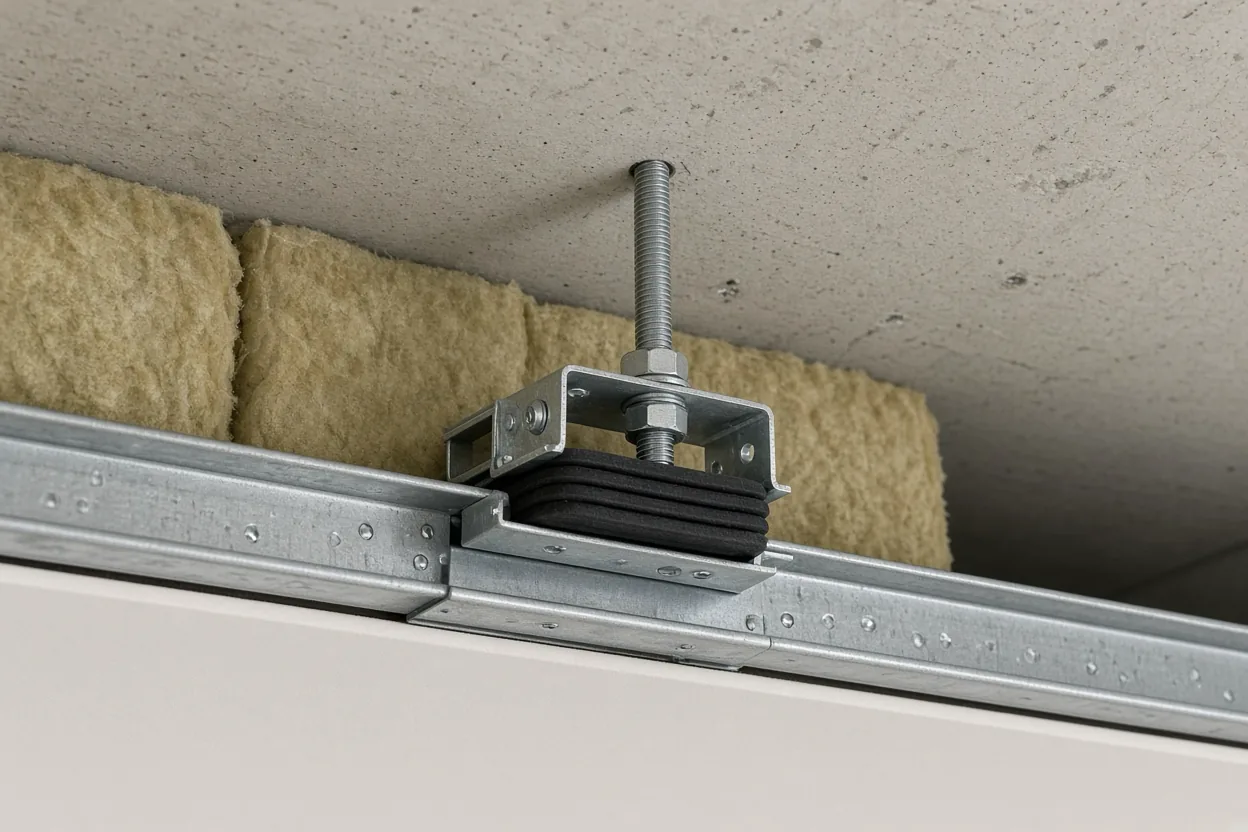
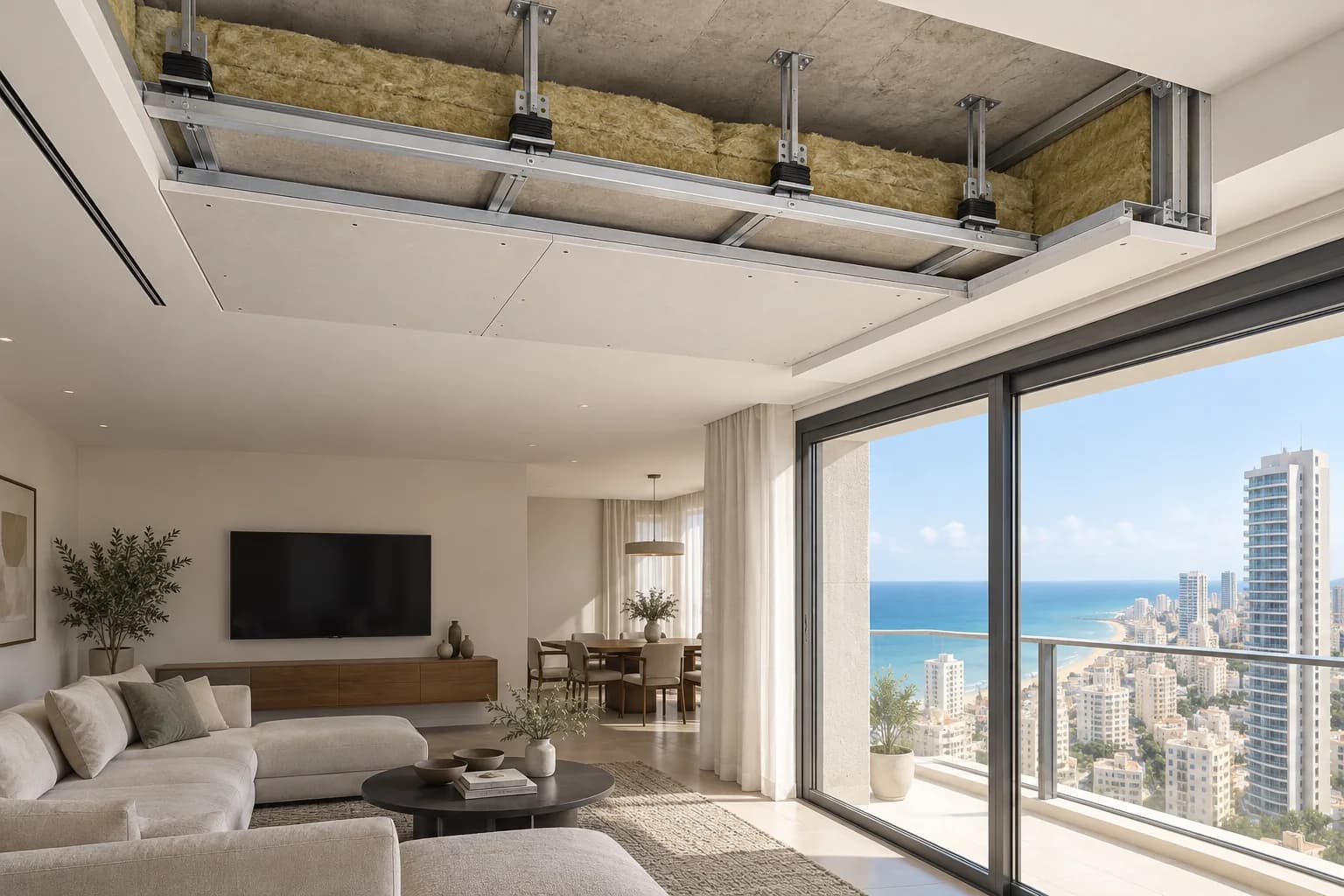
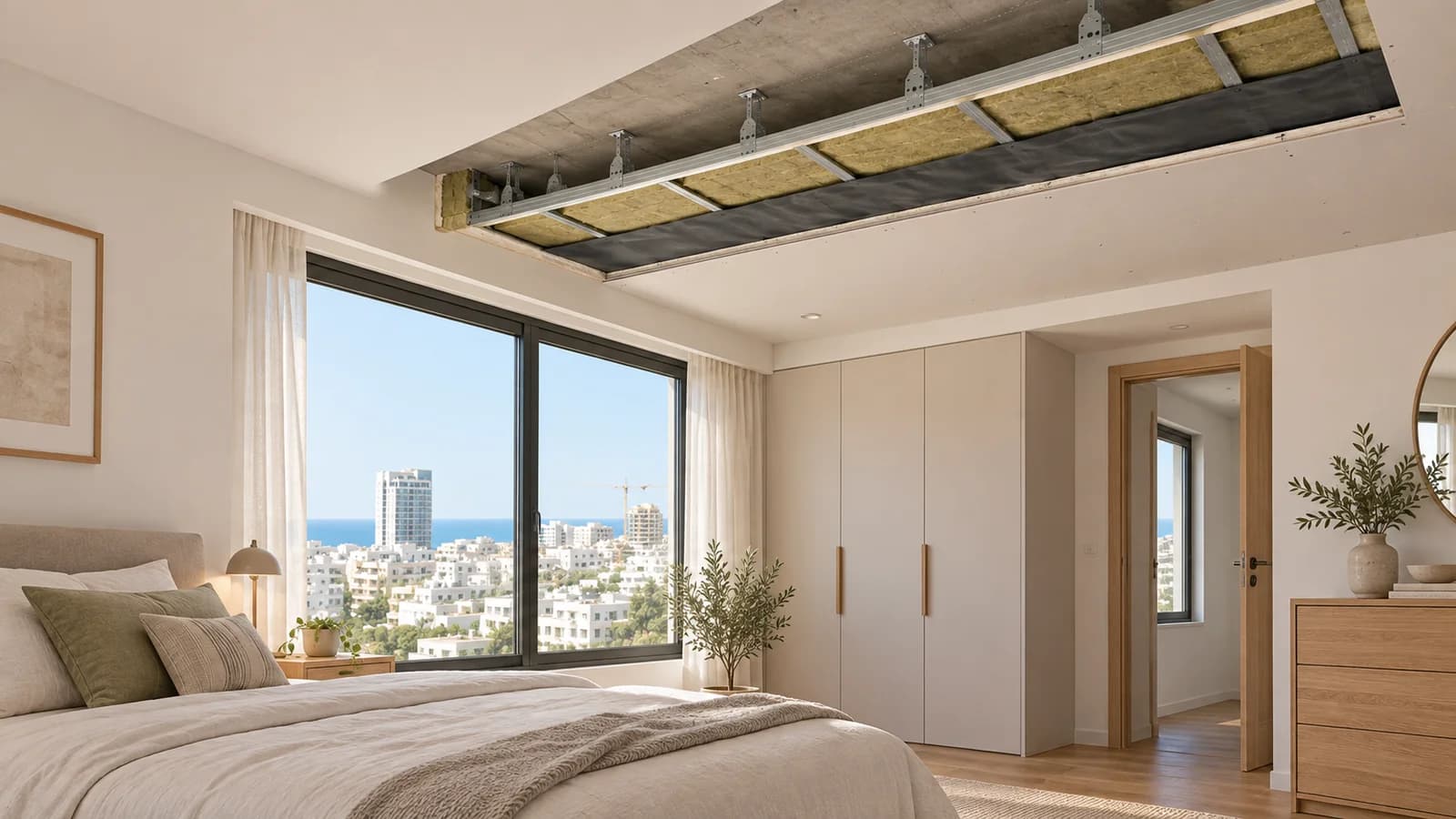
The key idea is decoupling. Instead of fixing the drywall rigidly to the concrete, it is suspended so that the slab’s vibration barely reaches the boards. Some people call this a floating ceiling. A typical system looks like this, from top to bottom:
- Acoustic hangers — hangers with a rubber or spring element, anchored to the concrete and holding the rods or channels. The resilient element absorbs a large part of the vibration before it reaches the board.
- Metal channels — a grid of main and secondary channels that the boards are screwed to. The grid must be level and stable, but it must not touch the walls through a rigid fixing.
- Rock wool in the cavity — a layer of mineral wool above or between the channels, which absorbs sound in the air gap and stops it ringing between the concrete and the board.
- Drywall boards — one or two layers, usually standard 12.5 mm boards and sometimes denser acoustic boards. The mass of the boards is part of the isolation.
- Perimeter seal — a small gap between the boards and the wall, filled with flexible acoustic sealant so the ceiling does not touch the walls.
No single component works on its own. A resilient hanger without the mass of the boards achieves little, and mass without decoupling keeps passing vibration through. Workmanship is part of the system too: one screw long enough to reach the concrete, a rod touching a pipe or a channel screwed to the wall creates a “bridge” that bypasses the decoupling and wastes much of the investment. So during the job it is worth asking to see the hangers and the wool before the boards close them in, and taking photos for your records.
Our soundproof ceilings service page sets out the stages of the work as we carry them out.
4. Why an ordinary drywall ceiling, or wool alone, barely helps
A common mistake is ordering an ordinary suspended ceiling “with wool inside” and expecting quiet. A standard drywall ceiling hangs on rigid hangers and is usually connected to the walls through the perimeter channel. The slab’s vibration travels through the metal straight into the board, and the board keeps radiating sound into the room. Sometimes a closed air cavity between two rigid surfaces even emphasises certain frequencies — a resonance effect that anyone working in acoustics knows well.
Wool alone, without decoupling and without mass, also does little. Rock wool absorbs sound in the air, but it is light and porous and does not block it. Laying wool above an existing lay-in tile ceiling, or gluing foam panels to the ceiling, may reduce echo in the room but will hardly change the noise from the neighbours.
A quick comparison of the options
- Ordinary drywall ceiling — for lighting, hiding services and appearance. In our price list 288–468 ₪ per m². It is not a soundproofing solution.
- Resilient channel — a flexible metal strip that weakens the rigid link between board and slab. In the price list 54–114 ₪ per linear metre. Useful when height is very limited, but easy to short-circuit with a single wrong screw.
- Decoupled ceiling on acoustic hangers, with wool and boards — the main solution for noise from above. In the price list 456–900 ₪ per m².
The price difference between an ordinary and a soundproof ceiling comes from the hangers, the wool, the extra layer and the sealing — and above all from careful workmanship. If the goal is only to lower the ceiling, hide pipes or build in lighting, an ordinary drywall ceiling is the right and cheaper choice, and there is no reason to pay for isolation you do not need. Our guide to drywall ceilings in Israel covers those options in detail.
5. Wool, one or two board layers and depth: choosing the build-up
There is no single build-up that suits every flat. The choice depends on the type of noise, the room height and what runs through the ceiling. These are the main decisions you make together with the contractor after seeing the room:
- Rock wool — a layer that fills a substantial part of the cavity without being squashed. Compressed wool works less well, so its thickness has to match the depth. In the price list, mineral (rock) wool acoustic insulation as a separate item is 102–192 ₪ per m².
- One or two board layers — a second layer adds mass and mainly improves performance against voices and airborne noise. It is fixed with the joints staggered from the first layer. An extra acoustic board layer in the price list: 156–288 ₪ per m².
- Ceiling depth — the hanger, channels and wool need room. Typically this is in the order of ten centimetres, and sometimes more when ducts or pipes run above.
What this looks like in buildings across the region
In older block-and-plaster apartment buildings in Haifa and the Krayot, ceilings are often relatively high, so giving up a few centimetres is easier. On the other hand, the ceiling plaster may be cracked or uneven, and you need to check where the hangers will anchor securely into the concrete. In the new high-rise towers of Netanya and Harish, height is used more tightly, and there is often already a drywall ceiling or bulkhead for a ducted mini-central air conditioner. Then you have to decide whether to remove what is there or build below it, and how to integrate the ducts. Hard tiled floors throughout the flat above make footsteps a common complaint in such buildings. Similar considerations appear in our article on ceiling soundproofing in Hadera and Or Akiva, and the wider picture is on the acoustics and soundproofing page.
6. The perimeter and weak points: where noise sneaks around the ceiling
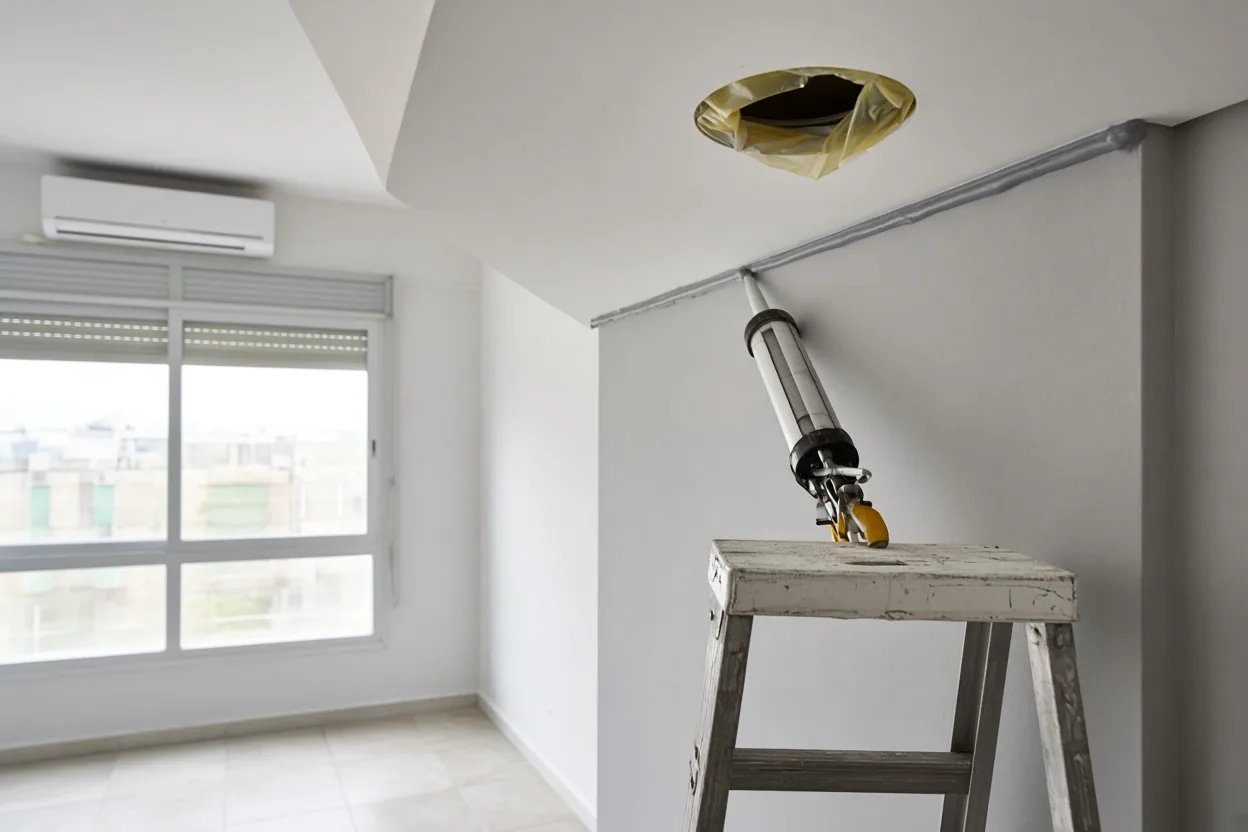
A decoupled ceiling is only as good as its weakest point. The first place performance is lost is the perimeter — the line where the ceiling meets the walls. If the boards are pressed against the wall, if the perimeter channel is screwed to the wall without an isolating tape, or if the corner is closed with rigid filler, you get a rigid connection that carries vibration from the walls into the new ceiling. On top of that, a rigid corner like this tends to crack over time.
How to do the perimeter properly
- Leave a small, even gap between the edge of the boards and the wall.
- Separate the perimeter channel from the wall with acoustic tape.
- Fill the gap with a flexible acoustic sealant that stays elastic, and only then paint. In the price list: 33.6–72 ₪ per linear metre.
- Seal every pipe, cable or rod that passes through the ceiling, and leave no holes “for later”.
The second weak point is openings. Every recessed spotlight, every air-conditioning grille and every electrical box is a hole in the sealed layer, and more sound passes through a small hole than you would think. That is why a cover hood is fitted above each recessed light — a box made of board or a purpose-made product suited to the heat of the fitting — and sealed to the board. Leak paths like these, including sockets and vents, are described in our article on sound leaks through outlets, vents and the ceiling.
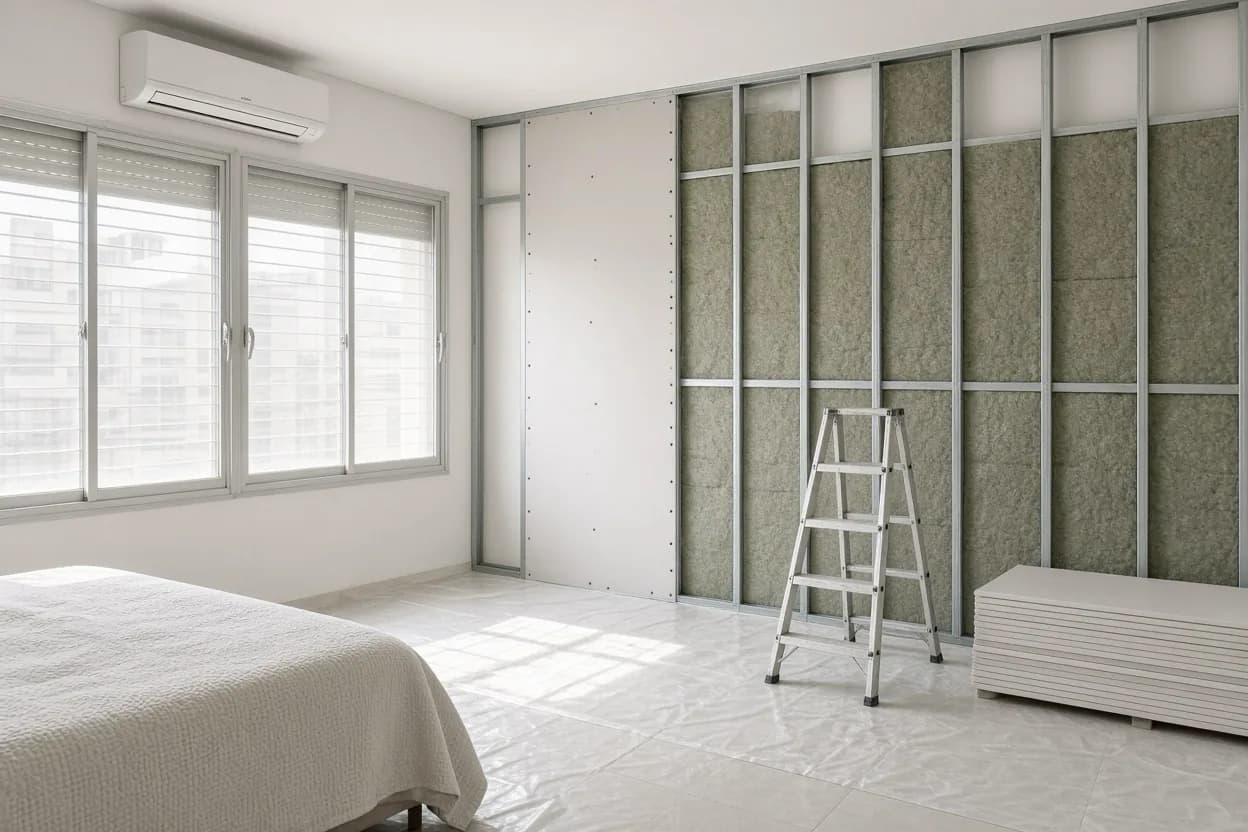
Check the walls themselves too. If a light drywall partition runs up to the concrete, sound can travel down its cavity and bypass the ceiling. This is spotted during the site survey, before the build-up is decided, not after the ceiling is already painted.
7. Spotlights, air conditioning and access panels without ruining the isolation
Almost every bedroom or living-room ceiling includes lighting, and often air conditioning too. Both are planned before the boards are closed, not afterwards. Any change after finishing means cutting, resealing and filling — and sometimes damaging isolation you have already paid for.
Lighting
- Fewer spotlights are better than many. Each one is a hole that has to be cut, hooded and sealed. A spotlight cut-out in the price list: 66–144 ₪ per unit; ask whether the hood above the light is included.
- A surface-mounted fitting, or a track with few power points, needs fewer openings.
- A heavy pendant or a ceiling fan needs a planned fixing point. Fixing it rigidly to the concrete through the ceiling creates a bridge, so this is worked out in advance.
- Wiring and connections are done by an electrician. We coordinate the positions and openings with them.
Air conditioning and ducts
With a ducted mini-central air conditioner, ducts run above the ceiling and the supply and return grilles pass through the boards. The joint between duct and board must be sealed, and the duct must not be rigidly fixed to both the concrete and the ceiling. The unit itself and its filters need access, which is provided by a hidden access panel — 456–984 ₪ per unit in the price list. Such a panel should close tightly, not be a lid resting loosely on a frame.
Pipes from a wall-mounted air conditioner, or a condensate line running along the wall, can be hidden in a drywall box for AC pipes; a perimeter ceiling box costs 252–432 ₪ per linear metre in the price list. Moving an AC unit or altering ducts is work for an air-conditioning technician, and it should be coordinated before the ceiling work starts.
8. Ceiling soundproofing cost per m²: what moves the price and what is included
The price per square metre is a starting point, not the full answer. Two quotes with the same rate per m² can include completely different things. These are the main factors that move the total:
- Height and access — a high ceiling, a narrow stairwell or the need for scaffolding slow the work down.
- Area — a small room has a fixed amount of work (preparation, covering, removal of waste) spread over fewer metres.
- System build-up — wool thickness and one or two board layers.
- Removing the existing ceiling — old drywall, and finding out what is hidden above it.
- Lighting and openings — spotlights, AC grilles, smoke detectors and access panels.
- Boxes and bulkheads at the perimeter — for pipes, curtains or a change of level near a window.
- Finishing — ceiling skim coat and painting, which are not always included in the base rate.
- Occupied home — moving furniture, covering and dust protection, working in phases, parking and the lift.
| Price-list item | Price range | Unit |
|---|---|---|
| Ceiling soundproofing (decoupled system) | 456–900 ₪ | m² |
| General soundproofing systems (walls and rooms, for comparison) | 384–780 ₪ | m² |
| Resilient channel | 54–114 ₪ | linear m |
| Mineral (rock) wool acoustic insulation | 102–192 ₪ | m² |
| Extra acoustic board layer | 156–288 ₪ | m² |
| Acoustic sealant | 33.6–72 ₪ | linear m |
| Old drywall ceiling removal | 72–144 ₪ | m² |
| Standard drywall ceiling (not acoustic, for comparison) | 288–468 ₪ | m² |
| Hidden access panel | 456–984 ₪ | unit |
| Spotlight cut-out | 66–144 ₪ | unit |
| Perimeter ceiling box | 252–432 ₪ | linear m |
| Ceiling skim coat | 66–144 ₪ | m² |
| Ceiling painting | 66–132 ₪ | m² |
| Site survey | 360 ₪ | visit |
| Online consultation and detailed estimate | free | — |
These are ranges from the NikoGips price list (November 2026). The final price depends on what the site survey finds, and in every quote it is worth checking whether VAT (ma’am) is stated. The full list is on our drywall and soundproofing prices page.
Note that rock wool and an extra board layer also appear in the price list as separate items. Ask for it to be written explicitly whether they are included in the base line or added to it — so they are neither counted twice nor quietly dropped from the job.
9. Finishing, painting and living with a lower ceiling
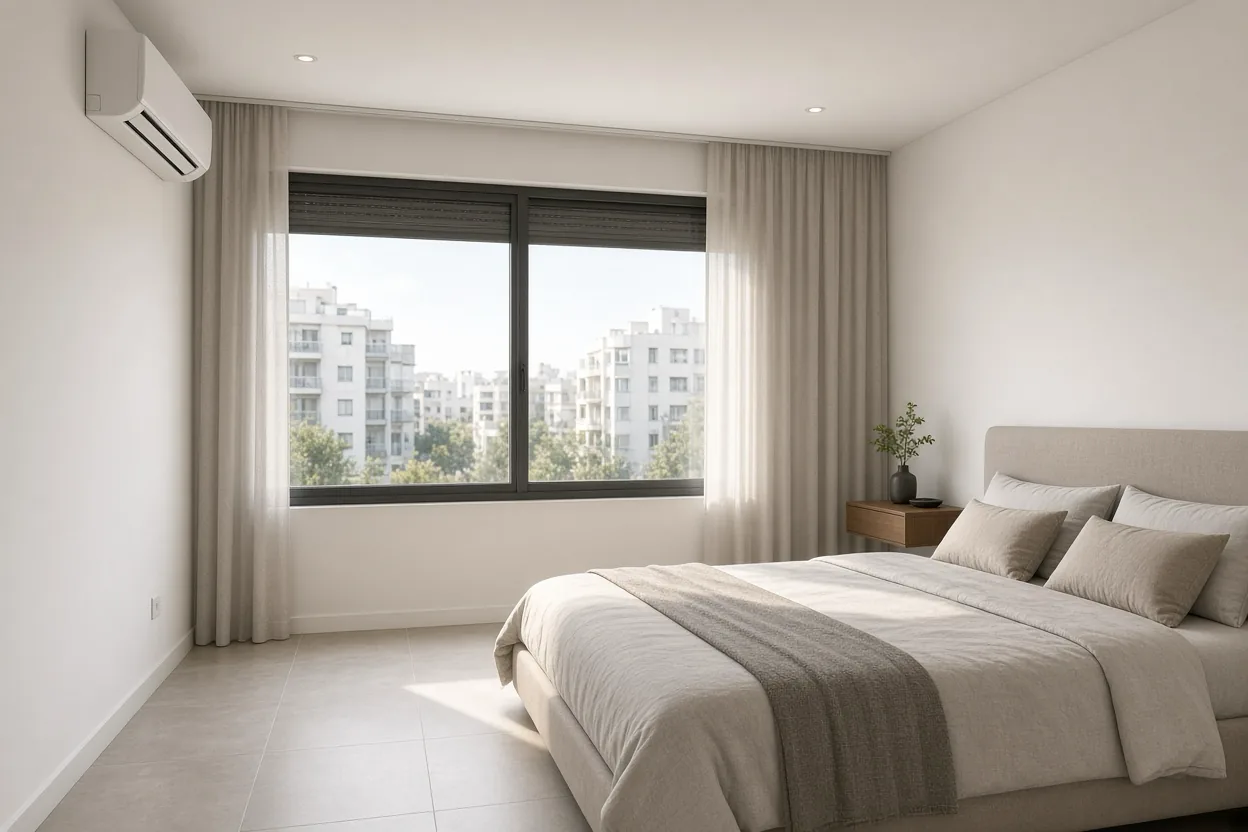
Once the boards are closed, the ceiling should look like any good ceiling: smooth, white, without visible joints and without cracks in the corners. The joints and screw heads are treated, the surface is skimmed where needed (66–144 ₪ per m² in the price list) and painted (66–132 ₪ per m²). The junction with the wall stays on flexible sealant, which is painted over rather than closed with rigid filler — that is how cracks along the perimeter are avoided. More on surface preparation and paint is on the ceiling painting page.
What the lost height means in practice
- Windows and roller shutters — measure the distance from the concrete to the window head and to the shutter box. If the new ceiling comes close to them, plan a step or a bulkhead above the window.
- Curtains — a rail screwed into the concrete will need a new position. A hidden curtain pocket can be planned at the ceiling stage.
- Wall-mounted air conditioner — the unit needs clearance above it for air intake. If the ceiling comes down, it may have to be moved, which is work for an AC technician.
- Wardrobes and doors — a built-in wardrobe that reaches the old ceiling, or an unusually tall door, may clash with the new height.
- Lighting — with a lower ceiling, slim fittings and even light distribution work better.
As for the result: after the work most of the noise can be expected to sound quieter and more muffled, especially voices. Heavy knocks and footsteps may still be audible, but less sharp. It is best to judge the change over several ordinary evenings, not on the first night.
10. Worked example: ceiling soundproofing cost for a 14 m² bedroom
Take a bedroom of 3.5 by 4 metres: 14 m² of ceiling and a perimeter of 15 linear metres. This is arithmetic on the price-list ranges only, not a quote. In a real room the quantities and build-up are set by the survey.
| Line | Calculation | Range |
|---|---|---|
| Decoupled soundproof ceiling | 14 m² × 456–900 ₪ | 6,384–12,600 ₪ |
| Ceiling skim coat | 14 m² × 66–144 ₪ | 924–2,016 ₪ |
| Ceiling painting | 14 m² × 66–132 ₪ | 924–1,848 ₪ |
| Base subtotal | — | 8,232–16,464 ₪ |
| Extra acoustic board layer | 14 m² × 156–288 ₪ | 2,184–4,032 ₪ |
| Acoustic sealant at the perimeter (if listed separately) | 15 linear m × 33.6–72 ₪ | 504–1,080 ₪ |
| Four spotlights | 4 × 66–144 ₪ | 264–576 ₪ |
| Subtotal with second layer, sealant and spotlights | — | 11,184–22,152 ₪ |
| Old drywall ceiling removal | 14 m² × 72–144 ₪ | 1,008–2,016 ₪ |
| One hidden access panel | 1 × 456–984 ₪ | 456–984 ₪ |
| Total with removal and access panel | — | 12,648–25,152 ₪ |
The site survey (360 ₪) is not included in the calculation. A few conclusions from the table:
- Dividing the full scenario by 14 m² gives roughly 903–1,797 ₪ per m² of room. That is why comparing quotes on the base line alone can mislead.
- The additional lines — second layer, sealant, spotlights, removal and access panel — add more than half of the base subtotal here.
- The range is wide because it covers very different conditions. The survey is what narrows it down to one figure.
11. Comparing quotes line by line, and why an acoustic ceiling for echo is different
When two or three quotes arrive, the total at the bottom is the last thing to compare. Go through the lines first and check:
- Whether it says “acoustic hangers” or “decoupled system” — not just “drywall ceiling”.
- The type and thickness of the wool, and whether it is included in the rate per m².
- The number and type of board layers.
- Perimeter sealing with flexible sealant — included or separate, and for how many linear metres.
- How many spotlights, AC grilles and access panels, and what is done above each opening.
- Removal of the existing ceiling and disposal of the waste.
- Skim coat and painting — included or not.
- Protection of furniture and floors in an occupied home.
- Whether the prices include VAT.
Soundproofing versus an “acoustic ceiling”
A common trap is a quote for an “acoustic ceiling” that turns out to be a mineral-tile ceiling or perforated drywall. These products absorb sound inside the room and reduce echo — excellent for a noisy living room, an office or a meeting room — but they are light and full of openings, so they do very little against noise from the neighbours. If your problem is echo, read about acoustic ceilings for echo reduction and about acoustic ceiling price per m². If your problem is the neighbours upstairs, what you need is isolation: mass, decoupling and airtightness.
Mistakes to avoid: choosing the lowest price when the build-up is not specified, cutting the perimeter sealing to save money, and adding spotlights after the ceiling is already closed.
12. Next step: what to send for a quote
A detailed estimate needs only a few simple details. You can collect them with your phone in a few minutes:
- Photos of the whole ceiling, the corners, the window, the air conditioner and the light points.
- Room dimensions — length and width — and the height from floor to ceiling.
- The distance from the ceiling to the window head or the shutter box.
- A short description of the noise: what you hear, when and from where.
- A floor plan of the flat, if you have one.
- Whether there is an existing drywall ceiling, a ducted air conditioner or pipes in the ceiling.
Based on this material you can get a free online consultation and a detailed estimate. When something needs checking on site — anchoring, an existing ceiling, ducts or the source of the noise — a site survey is arranged at 360 ₪ per visit, according to the price list. We work from Haifa and the Krayot through Tirat Carmel, Atlit, Yokneam, Zikhron Yaakov, Binyamina, Pardes Hanna–Karkur, Caesarea, Or Akiva, Hadera and Harish to Netanya, Herzliya, Ra’anana, Kfar Saba, Hod HaSharon and Tel Mond. All the ranges are in the NikoGips price list, and you can arrange a consultation through our contact page. More about the system itself is on the ceiling soundproofing service page.
Questions
How much does ceiling soundproofing cost per m² in Israel?
According to the NikoGips price list (November 2026), ceiling soundproofing with a decoupled system costs 456–900 ₪ per m². An extra board layer (156–288 ₪ per m²), removal of an old ceiling (72–144 ₪ per m²), spotlights, access panels, skim coat and painting may be added. The final price is set after a site survey, and in every quote it is worth checking whether VAT is included and what exactly the base line covers.
Will a soundproof ceiling stop footsteps from upstairs completely?
Not completely. Footsteps are created in the neighbours’ floor and travel through both the concrete and the walls. A decoupled ceiling reduces what the slab radiates into your room, so the noise usually becomes quieter and more muffled, but heavy knocks may still be heard. The most effective fix for impact noise is usually in the neighbours’ floor, such as a resilient underlay or rugs, and that is work outside our trade.
How much ceiling height do you lose with a soundproof ceiling?
It depends on the hangers, the wool thickness and what runs above the ceiling. Typically it is in the order of ten centimetres, sometimes more when there are AC ducts or pipes. Before deciding, measure the current height, the distance to the window head and shutter box, and the clearance above any wall-mounted air conditioner, so you know whether a step, a bulkhead or moving a unit needs planning.
Can I just add insulation above my existing drywall ceiling?
It can be checked, but the gain is usually small. An existing ceiling on rigid hangers that is connected to the walls keeps passing vibration even with wool above it. Sometimes a decoupled ceiling can be built below the existing one; sometimes it is better to remove it (72–144 ₪ per m² in the price list) and build a proper system from the concrete. The decision depends on height, the ceiling’s condition and what is hidden above it.
Can we keep living in the flat while the ceiling is being done?
In most cases yes, especially when it is one room. Furniture in the room is moved out or covered, the floor and walkways are protected, and the room is closed off to limit dust. Working in an occupied home needs coordination of hours, parking and the lift, which also affects the price. Ask for the quote to spell out what is included in protection, waste removal and cleaning at the end of each working day.
What is the difference between ceiling soundproofing and an acoustic ceiling?
Ceiling soundproofing is meant to block noise coming from outside the room, such as from the neighbours upstairs, using mass, decoupling and airtightness. An acoustic ceiling in the usual sense — mineral tiles or perforated boards — absorbs sound inside the room and reduces echo. It makes a noisy room more comfortable but does very little against neighbour noise. When you need both isolation and echo control, the two can be combined.
Relevant services
Guides and practical notes
Message Nikolai on WhatsApp with photos and dimensions, or call him to discuss the next step and what is needed for an estimate.